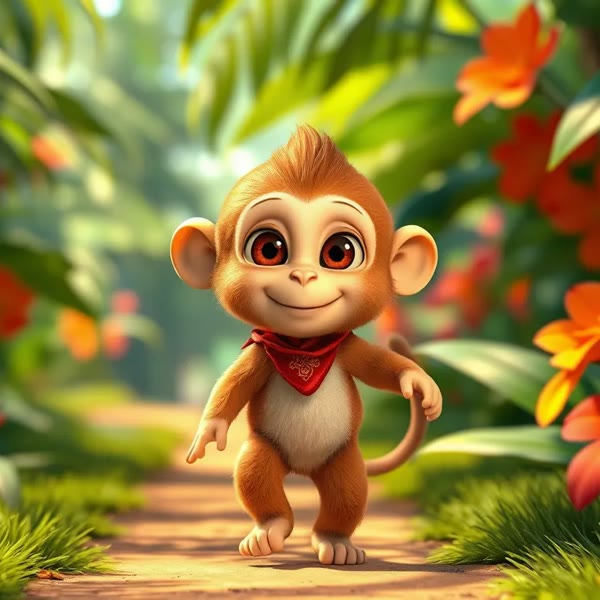
Learning colors. Your child hears the name of a color and touches the matching circle. Red, blue, yellow and green first, then orange, pink, purple and black: color recognition is built through listening and doing, with no reading. A preschool game to play with a grown-up the first few times, naming the color together.
Learning to count from 1 to 9. Bananas appear one by one for Kiko; your child counts them and touches the right number. Level 1 goes from 1 to 3 with two numbers to choose from, level 3 goes up to 9. It works on the counting sequence, on matching a quantity to a numeral, and on recognizing written numbers.
Memory and attention. A classic memory game with the animals from Kiko’s jungle: 3, 4 or 6 pairs depending on the level. Each card is named out loud when it is turned over, which builds animal vocabulary along with visual memory and concentration.
Finding your way in space. The heroes of the cartoons — Dino, Kiko, the parrot, the tortoise, the baby elephant, the rabbit — in 4, 6 or 9 pieces. No drag and drop, which is too hard before age 4: touch one piece, then another, and they swap places. Your child learns to look closely at a picture and to find top, bottom, left and right.
Observation and recognizing shapes. An animal appears only as a shadow; your child recognizes its outline among two, three or four choices. It is an exercise in careful observation and sorting, an early step toward reading shapes and letters.
The first touch on a screen. Bubbles rise slowly and your child pops them with a finger. It is the very first game for little ones: learning to aim, to touch at the right moment, to coordinate eye and hand. At level 3 the bubbles are small and fast.
Learning shapes. Circle, square, triangle, star, heart, moon, diamond: the voice names a shape and your child touches it. Recognizing simple geometric shapes is part of preschool learning and prepares for writing.
Big, small, medium. Three identical animals in different sizes: touch the biggest, the smallest, then the medium one at level 3. Comparing sizes is the beginning of logical thinking and of the vocabulary of opposites.
Animal sounds. Twenty-six real animal recordings: the cow, the wolf, the owl, the dolphin, the whale… Your child listens and touches the animal that makes the sound. Listening skills, farm animals and wild animals, vocabulary.
Sorting: find the odd one out. Several pictures the same and one that is different: three fruits and an animal, three vehicles and a flower. Finding the odd one out means sorting the world into families — one of the big steps between ages 3 and 5.
Coloring like the model. The colored model is next to it, the drawing to fill in is below: your child chooses a color, then touches an area. Twenty-five drawings, including Kiko, Dino and their friends. It works on colors, on looking at a model and on a precise touch, without ever going over the lines.
Patterns and sequences. Banana, apple, banana, apple… and then? Your child continues the pattern: AB at level 1, AAB at level 2, ABC at level 3. Simple repeating patterns are part of kindergarten learning and prepare for math.
Animals and their food. An animal is hungry; your child touches what it eats among two, three or four choices: the monkey’s banana, the rabbit’s carrot, the mouse’s cheese… Matching, naming animals and foods, and building vocabulary by listening to the instruction.
Weather and clothes. The sky shows the weather; your child picks what is needed to go outside: the cap in the sun, the umbrella in the rain, the scarf when it snows. Observing the weather, naming clothes and planning ahead: a small, very concrete cause-and-effect reasoning.
Recognising feelings. The voice names a feeling (happy, sad, angry, sleepy, surprised, scared) and your child touches the face that shows it, among two, three or four. Putting words on what a face shows is the beginning of empathy: talk about it together after the game, “and you, when are you angry?”.
Observing and comparing. Four, six or nine pictures, and only two are identical; your child touches them one after the other. At level 3 the other pictures look very similar (a red apple and a green apple, a dog and a wolf): fine visual discrimination, the skill that will later tell a b from a d.
Following a path with the eyes. Two, three or four paths tangle between animals and what they are looking for; your child follows with the eyes the path that reaches the banana and touches the animal at its start. At level 3 all paths have the same colour: you really have to follow the line. Visual attention, eye tracking and orientation, nothing to write.